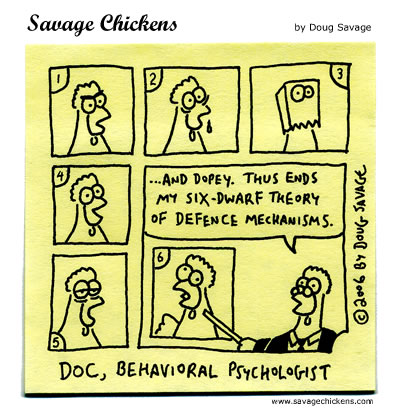
DISPLACEMENT
It is the redirection of drive energy towards a substitute object, is one of the most common defence mechanisms and is used typically whenever the direct expression of drives would be too threatening, due to either the disapproval of superego or a realistic threat associated with the original object; in such situations we tend to seek a substitute object. The substitute object is normally a good friend, or family or pet.
There was a time in school when it seemed that all the teachers had something against me .Almost every teacher is school loaded us with homework and at same time got very angry with me for some stupid reason or other. I was really annoyed because I would do all the homework on time and do my best in all the tests, and the teachers shouted at me for absolutely no rhyme or reason.
When I went home I was tired and frustrated and wanted to go to sleep but my mother insisted that I work on my big art project. I knew I would not be allowed to get peace of mind even at home so I just decided to work. When I finished working my younger brother came upto me and asked to play but I refused. He took his toy and tried to spoil my art work. At that very instance I slapped him really hard and started shouting at him.
He said that he did not mean to spoil my art work and started crying. I then realized that I had taken all my frustration out on my little brother. I felt really horrible after that but it did not take more than fifteen minutes for me and my brother to patch up.
This would be called displacement as I redirected anger and frustration from my teachers (one object) to my brother (substitute object).
IDENTIFICATION
Identification is incorporating one’s drive object into one’s ego. It occurs with those individuals who are either admired or feared. For instance, hostages may come to adopt some of the values of their captors. In movies, books or plays, identification with a character can provide a form of release called catharsis- the vicarious release of drive energy. When we are unable to directly express sexual or aggressive impulses, we may adopt the guise of a figure in whom such impulses are acceptable.
I remember the time when I was crazy about a Bollywood actress. I loved to watch her onscreen and would always imitate her. I would watch her movies again and again. I would imitate her dance moves and even say the same dialogues as her. My friends and family did not stop me from doing that nor did they encourage me. As I grew elder I started getting over my craze for her and her dance moves.
RATIONALIZATION
It is one of most interesting defences; it involves offering an acceptable reason for behaviour in place of the true reason (acceptable to the ego, though the approval of the other people may be a concern as well).When we engage in rationalization, we try to justify our actions. Rationalization may be combined with other defences as well, to provide a justification for behaviour. Rationalization may protect self-esteem and self- concept and prevents anxiety. In case of failures people tend to blame it on others or outside forces.
Every time I am lazy to do a particular task, I land piling up a lot of work. Although I am aware of the consequences, I happen to take it easily thinking that I will be able to handle it. Once I faired poorly in my test and I blamed it all on the extensive amount of work that I had.
This can be a good example of rationalization.
REACTION AND FORMATION
Reacting in a way which is opposite to one’s actual impulses; it reduces anxiety by taking up an opposite feeling. It is used to hide the true feelings.
I always try and hide my feelings in front of the people I don’t know. I was not very fond of my teacher because he would always minus marks or reduce my grades for no rhyme or reason and it was not possible for me take out my frustration and anger on him.
I did not want to get detention or be shouted at in return. Instead I would give him smile every time I would see him and try and be very calm around him as if he had done nothing to me. In such a way I would help myself and avoid more grave consequences that I would have to bear.
SUBLIMATION
In Freud’s theory, a defence mechanism in which drives energy is redirected toward a socially desirable creative activity. While sublimation is useful, because it results in a socially useful product, it is also limited as gratification is indirect and cannot fully satisfy demands of the id. The creative activity that which sublimation supports makes it more than simply a response to neurotic activity.
For e.g. I was extremely in love with peacocks at a very young age and because I had never gotten a chance to see peacocks at that point, I would sit and draw pictures of peacocks. I drew so many of them that every time I drew it, I got better at it and eventually I was so good that people would appreciate it and compliment me for those several peacocks that I had drawn.
It is the redirection of drive energy towards a substitute object, is one of the most common defence mechanisms and is used typically whenever the direct expression of drives would be too threatening, due to either the disapproval of superego or a realistic threat associated with the original object; in such situations we tend to seek a substitute object. The substitute object is normally a good friend, or family or pet.
There was a time in school when it seemed that all the teachers had something against me .Almost every teacher is school loaded us with homework and at same time got very angry with me for some stupid reason or other. I was really annoyed because I would do all the homework on time and do my best in all the tests, and the teachers shouted at me for absolutely no rhyme or reason.
When I went home I was tired and frustrated and wanted to go to sleep but my mother insisted that I work on my big art project. I knew I would not be allowed to get peace of mind even at home so I just decided to work. When I finished working my younger brother came upto me and asked to play but I refused. He took his toy and tried to spoil my art work. At that very instance I slapped him really hard and started shouting at him.
He said that he did not mean to spoil my art work and started crying. I then realized that I had taken all my frustration out on my little brother. I felt really horrible after that but it did not take more than fifteen minutes for me and my brother to patch up.
This would be called displacement as I redirected anger and frustration from my teachers (one object) to my brother (substitute object).
IDENTIFICATION
Identification is incorporating one’s drive object into one’s ego. It occurs with those individuals who are either admired or feared. For instance, hostages may come to adopt some of the values of their captors. In movies, books or plays, identification with a character can provide a form of release called catharsis- the vicarious release of drive energy. When we are unable to directly express sexual or aggressive impulses, we may adopt the guise of a figure in whom such impulses are acceptable.
I remember the time when I was crazy about a Bollywood actress. I loved to watch her onscreen and would always imitate her. I would watch her movies again and again. I would imitate her dance moves and even say the same dialogues as her. My friends and family did not stop me from doing that nor did they encourage me. As I grew elder I started getting over my craze for her and her dance moves.
RATIONALIZATION
It is one of most interesting defences; it involves offering an acceptable reason for behaviour in place of the true reason (acceptable to the ego, though the approval of the other people may be a concern as well).When we engage in rationalization, we try to justify our actions. Rationalization may be combined with other defences as well, to provide a justification for behaviour. Rationalization may protect self-esteem and self- concept and prevents anxiety. In case of failures people tend to blame it on others or outside forces.
Every time I am lazy to do a particular task, I land piling up a lot of work. Although I am aware of the consequences, I happen to take it easily thinking that I will be able to handle it. Once I faired poorly in my test and I blamed it all on the extensive amount of work that I had.
This can be a good example of rationalization.
REACTION AND FORMATION
Reacting in a way which is opposite to one’s actual impulses; it reduces anxiety by taking up an opposite feeling. It is used to hide the true feelings.
I always try and hide my feelings in front of the people I don’t know. I was not very fond of my teacher because he would always minus marks or reduce my grades for no rhyme or reason and it was not possible for me take out my frustration and anger on him.
I did not want to get detention or be shouted at in return. Instead I would give him smile every time I would see him and try and be very calm around him as if he had done nothing to me. In such a way I would help myself and avoid more grave consequences that I would have to bear.
SUBLIMATION
In Freud’s theory, a defence mechanism in which drives energy is redirected toward a socially desirable creative activity. While sublimation is useful, because it results in a socially useful product, it is also limited as gratification is indirect and cannot fully satisfy demands of the id. The creative activity that which sublimation supports makes it more than simply a response to neurotic activity.
For e.g. I was extremely in love with peacocks at a very young age and because I had never gotten a chance to see peacocks at that point, I would sit and draw pictures of peacocks. I drew so many of them that every time I drew it, I got better at it and eventually I was so good that people would appreciate it and compliment me for those several peacocks that I had drawn.
Sources cited-
Glassman, William, and Marilyn Hadad. Approaches to Psychology. 4th
http://www.savagechickens.com/images/chickendwarf.jpg
Pictureshttp://www.savagechickens.com/images/chickendwarf.jpg


